The Father-in-Law
Die, My LoveThe Father-in-Law is the narrator's husband's father, a man whose presence in the book is felt most acutely through his absence. He dies in his sleep, and his death becomes a lens through which the narrator examines the rituals, secrets, and emptiness of the family she married into. His legacy is a strange compound of mundane domesticity and latent violence: a man who kept a rifle in his bedroom and a log of monthly expenses on his desk, who mowed the lawn beneath the snow on a green tractor and who, with his dying breath, declared that his grandson would follow in his footsteps.
Identity and Daily Habits
The Father-in-Law is introduced through the small, repetitive actions that define his days. He is a man of routine and record-keeping: after Christmas dinner, while the rest of the family digested their meals, he would sit at his desk going over last month's supermarket receipts, reading the price of each product and checking the total with a calculator before recording the sums in his log of monthly expenses. By the time he finished, the desk lamp no longer gave off enough light. He cleaned his dentures and went to bed. The narrator watches him and wonders, with bitter incredulity, whether this is a day lived, whether this is a human being living a day of his life. His habits are those of an average man who thinks he's exceptional, a figure the narrator remembers as a tired, backlit image.
His domestic life is marked by a strange combination of the mundane and the menacing. In his bedroom there is a rifle; on his night table, a few cartridges. He would say he would not be killed in his own bed, that if he heard noises he would load his gun and go downstairs, and if there was trouble he would fire — straight at the feet, he'd say, inhaling the saliva that was always caught in his throat. This threat of violence sits oddly beside his other habits: the way he complained about his teeth hurting or picked food out from between them as he spoke, the way he drove his tractor and laughed from atop it, the way he held forth in monologues from the head of the table.
The Christmas Scene and the Rifle
A pivotal memory of the Father-in-Law comes from the narrator's last memory of her pregnancy, at Christmas. His whole family had come to stay, and the narrator, desperate and overwhelmed, stood in the living room in front of the fire. As soon as the others had escaped to their rooms to digest their meals, she heard her father-in-law cutting the grass beneath the snow with his new green tractor. The image is almost surreal: a man mowing a snow-covered lawn on Christmas afternoon. Later she saw him at his desk with his receipts, and she reflects on the impossibility of his existence — how it was possible for her father-in-law to spend the afternoon before Christmas going over receipts with a firearm under his pillow. The juxtaposition of the accountant's meticulousness and the gunman's readiness defines him: a man who balanced his books and kept a weapon close, who prepared for intruders while recording the price of every product he bought.
Death and the Funeral
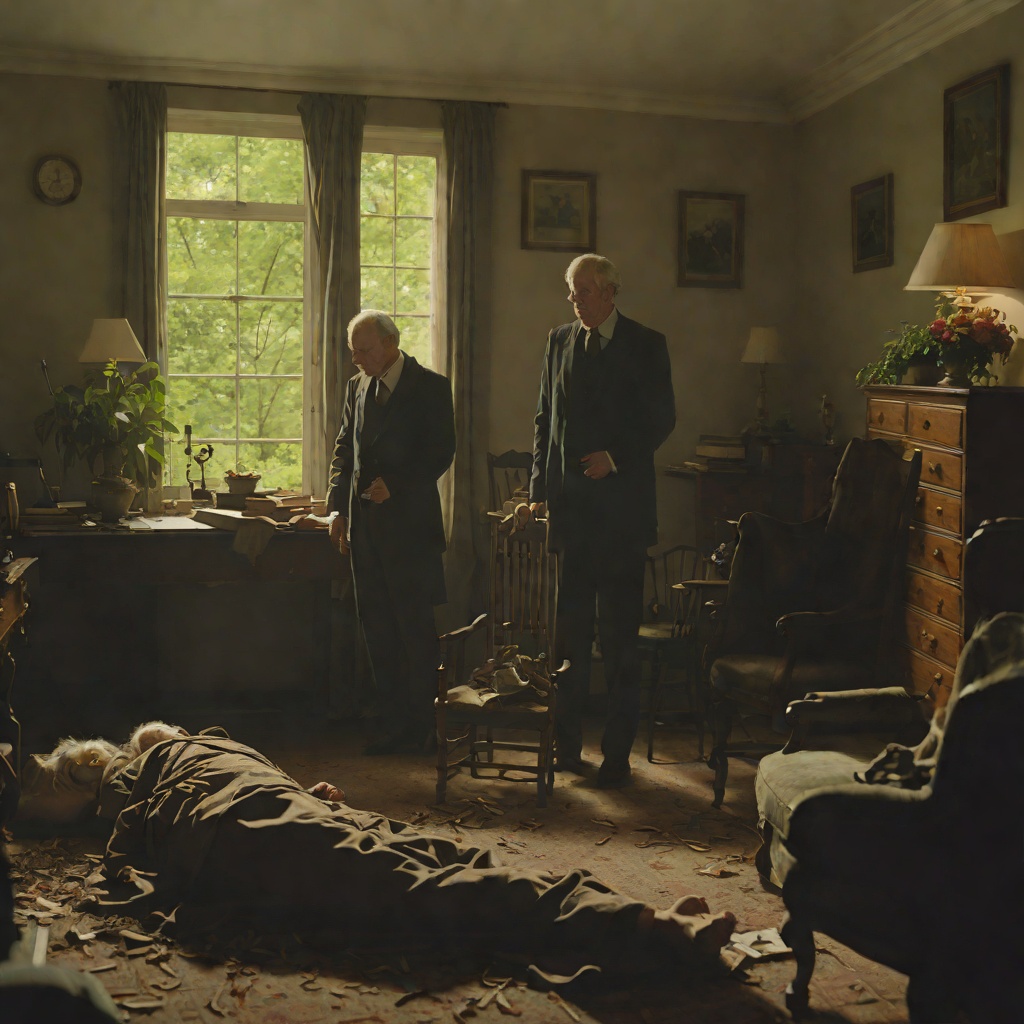
The Father-in-Law dies in his sleep, and his death is narrated with a mixture of grief, absurdity, and clinical observation. His last words before going to bed — 'My grandson will follow in my footsteps' — were meant as nothing more than a sweeping platitude, but they only make matters worse for the narrator, who is haunted by the weight of this inheritance. At his grave, the narrator is struck by a sudden, perfect image of his teeth: he was always either complaining that they hurt or picking food out from between them as he spoke. The funeral itself is a run-of-the-mill wake, a quick goodbye. The guests call him an excellent father and husband, better than excellent. The procession makes its way to eat at the inn where the dead man had been a regular, where he was there every lunchtime drinking his beer and his aperitifs, telling witty tales of his time on the front line.
But the widow reveals a different man: he used to sit for hours in the semidarkness of the living room facing the lit-up tree. The narrator reflects that it wasn't so much her father-in-law's death that affected her, but rather the loss of his words — 'In all my born days,' his turns of phrase, 'Well, I happen to be rather good at that' — and his thick, spit-filled tone. So much screwing around, so many memories of bravery from the war, so much debauchery, but in the end no one really had anything to say about him.
The Widow's Grief and the Revealed Secrets
The Father-in-Law's death transforms his wife, the Mother-in-Law, into a figure of perpetual mourning. She relives his death day after day, carrying on washing his trousers when he was gone, cooking for two, changing the pillowcases, mending his underwear that was torn at the crotch. She tells the family that her husband squeezed her hand tight just before he died, but that the doctor said it had only been a reflex reaction. It is at this moment that the narrator feels close to her for the first time. The Mother-in-Law's grief is a slow, agonizing process: she lives in her body as though it were an infested house, as if she had to tiptoe through it trying not to touch the floor. The only time she was at peace, she said, was in her sleep, when the spirit scatters. But she had serious difficulty sleeping and used to sleep-walk, once strolling through the village in a nightie shouting Fire!, another time using a shoe as a phone to converse with God.
The Father-in-Law's coffin contains more than his body. Locked inside the pinewood coffin are his pedantry, his monologues from the head of the table, his laughter from atop the tractor he drove — and the little secrets: the visits to the local brothel, the time his roving hand found its way under the skirt of a secondary-school student on the bus and it was the talk of the town. Also buried are the heroic exploits from his time in the navy, the deaths he tracked with marks in his groin, the game of cards in a train carriage at the age of thirty-two, and the time he made her laugh so hard she wet herself and had to hurry off to change. The narrator notes that although her father-in-law had never been one to spend long hours embedded inside his wife, entire afternoons, summers, clinging to her, nor days in the countryside entering her, satiating her; although he didn't even consider whether or not she got aroused — she was that hollow, that bare — he had been her companion nevertheless. Instead of a vagina, he thought his wife had a stone in the depths of a cave. He always imagined her covered in the little shawls she embroidered. He got used to loving her as though she'd been born that way. And she got used to being loved that way.
The Rifle and the Legacy
The Father-in-Law's rifle, kept beside his bed with cartridges on the night table, is a recurring symbol of his worldview — a man who expected trouble and prepared to meet it with force. His threat to fire straight at the feet of any intruder reveals a man who saw the world as a place of potential violation, where even his own home required armed defense. This violence is echoed in his attitude toward the moles that dug deep holes in the land around his house, turning it into a minefield. He used to say definitive action needed to be taken by putting gas bottles at the entrance to their homes: the Shoah of moles. The casual brutality of this plan — exterminating the moles with gas — mirrors the casual brutality of his other habits, from the brothel visits to the hand under the schoolgirl's skirt.
His final words — 'My grandson will follow in my footsteps' — hang over the narrative as a curse and a prophecy. The narrator, who is already struggling with motherhood and the suffocation of family life, hears in these words the threat of inheritance: the grandson will grow up to be like the grandfather, a man of receipts and rifles, of monologues and secrets, of violence and emptiness. The Father-in-Law's footsteps lead nowhere the narrator wants her son to follow. And yet the words were meant as nothing more than a sweeping platitude, a grandfather's casual blessing. The gap between what he intended and what the narrator hears is the gap between the normal family's self-image and its reality — a gap that defines the book's central critique. The Father-in-Law is the embodiment of that normal family, the most sinister kind, and his death does not end his influence but rather releases it into the narrator's consciousness, where it continues to haunt her.